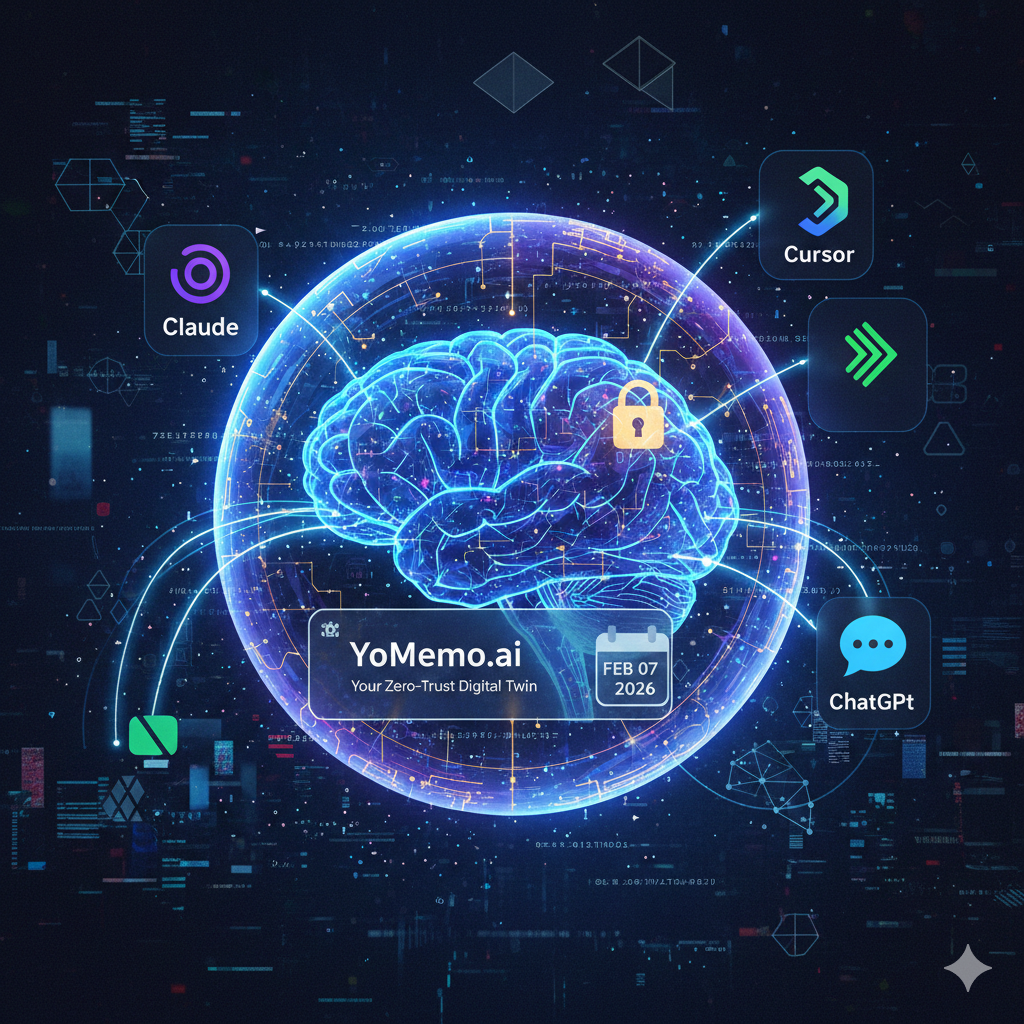
Zero-Trust Memory for Every LLM Session: Why I Built YoMemo
Tired of syncing context between Claude and Cursor via copy-paste? Meet YoMemo—a security-first memory relay designed to turn AI context into your private, lifelong digital twin.
The Pain: The "Clipboard Tax" of Modern AI
As a developer, my workflow is a constant hop between LLMs. I brainstorm architecture in Claude, execute implementation in Cursor, and polish documentation in ChatGPT.
But there is a hidden tax: The Clipboard Tax. Every time I switch tools, I lose the thread. The "Aha!" moment from an hour ago is trapped in another tab's history. While looking into open-source solutions like mem0, I hit a wall—Trust. I don't trust any centralized server with my most sensitive data. Whether it’s a medical report, a private brainstorming session for a pre-launch product, a unique decision-making pattern, or—let's be honest—the draft of an unfinished love letter to someone I never sent, I refuse to store it in plaintext on someone else's cloud.
The Philosophy: Zero-Trust or Bust
If a memory isn't private, it’s just data you're "renting" to an AI company. That’s why I built YoMemo.ai. It’s not just a storage layer; it’s a security-first memory relay.
We operate on a simple principle: We don't know you.
- Encrypt Before Send: Your memories are encrypted on the client side before they ever touch the wire.
- The "Black Box" Server: Our servers only see encrypted blobs and ciphertext. We use a hybrid crypto stack ($RSA-OAEP$ + $AES-GCM$) ensuring that only your local keys can unlock your past.
- Unified Protocol: Whether you use our MCP server, the browser extension, or our API, it’s one key pair and one decentralized memory store.
The Vision: From Storage to "Digital Twin"
YoMemo is evolving beyond a simple "Save" button. I want it to become the other "You"
By leveraging AI to filter the noise from the signal, YoMemo identifies the truly pivotal moments—your decision logic, your creative breakthroughs, and your behavioral trajectories over years, not just sessions.
I believe that what defines us is our trajectory of thought. Imagine an AI that doesn't just "know" the code you wrote yesterday, but understands why you wrote it that way based on a preference you established three years ago. We are building a bridge between fragmented AI sessions to create a continuous, private, and permanent human consciousness backup.